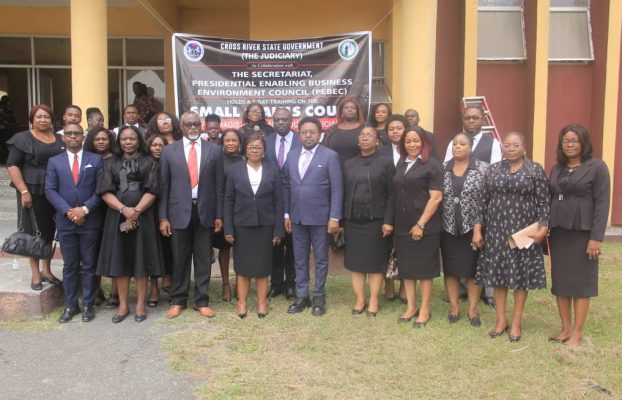
The birth of the Cross River State Judiciary dates back to the colonial era following the establishment of the Calabar Division of the High Court of Eastern Nigeria for the implementation of laws and resolution of conflict in the entire bounds of Eastern Nigeria. The High Court of Eastern Region had its Regional Headquarters at Enugu with a Chief Justice as the Head of the Judiciary.
Upon the Creation of the South Eastern State by virtue of State (Creation and Transitional Provisions) Decree No. 14 of I967 by the then Military Government, the State Judiciary became a separate entity following the inception of the South Eastern State which was inaugurated on 21st August 1968 and had jurisdiction over the territory now covering the present Cross River and Akwa Ibom States of Nigeria.
By 1969, there were two Judges along with the Chief Justice in addition to six Magistrates to cover the State with a population of about four million then and an area of over 11,000 square miles. On November 6th 1969, the State was divided into two Judicial Divisions namely, Calabar and Uyo Judicial Divisions along with seven magisterial districts. The Calabar Judicial Division consisted of Calabar, Oron, Ogoja ,Ikom, Obudu, Obubra while Uyo Judicial Division consisted of Uyo, Etinan, Opobo (now Ikot Abasi),Itu and Ikot Ekpene Administrative Divisions. The numerical strength of the judiciary staff expectedly was increasing and several appointments were made into the High Court Bench and the Magisterial Bench. Thus the State Judiciary was further divided into five judicial divisions, namely Calabar, Ogoja, Uyo, Ikot Ekpene and Eket to exercise jurisdiction along with fourteen Magisterial Districts which corresponded with the fourteen Administrative Divisions of the State.
There were also certain territorial adjustment by the then Federal Military Government of Nigeria which brought about the reconstitution of the South Eastern State under the present name Cross River State vide the States (Creation and Transitional Provisions) Decree No. 12 of 1976.
In 1980, the Chief Justice of Nigeria Sir Darnley A. R. Alexander who himself once headed the Cross River State Judiciary, directed that all HEADS of the High Courts of Nigeria, should cease to be addressed as “CHIEF JUSTICE” as they were usually addressed, but that from thence onward they were to be addressed as “CHIEF JUDGE” of the Federal Courts and States Courts respectively. However, only the Head of the Federal Supreme Court of Nigeria who was also the most senior Judicial Officer in Nigeria was to be addressed as the CHIEF JUSTICE OF NIGERIA.
The Cross River State Judiciary continued to operate under the jurisdictional status described above until 23rd of September 1987 when Akwa Ibom State was created by the then Military Government ,vide the State (Creation and Transitional Provisions) Decree No. 24 of 1987 out of the then Cross River State and the present Cross River State emerged with its own Judiciary.
Vision Statement
To expeditiously define citizens’ rights, settle disputes amicably, and protect weak and vulnerable groups as guaranteed under the law.
Mission Strategic Goals
SHORT TERM: To create a Judiciary efficient in disputes resolution; fast track case management system for peace, order and good governance in the state.
LONG TERM: To create an enhanced justice delivery system that is efficient, fast track in case management, technologically equipped, with multi-door avenue for disputes resolution, as to make for socio-economic and political advancement of our society.
Strategic Objectives
- Create an enhanced adjudication process as to quicken the dispensation of justice.
- Ensure fast tracking of all cases and eliminating backlog.
- Cultivate confidence in the Judicial process by;
- Safe guarding the rights and liberties of Citizens through an efficient multi-faceted justice delivery system
- Dispensing justice in accordance with the constitution and the law of the land.
- Enhancing a reformative penal system that impacts positively on all inmates.
- Effecting resolution of all disputes inter personal/Government, et al in an atmosphere devoid of fear or bias.
Main Functions Of The Judiciary
- Interpretation of Laws; The Judge interprets the laws of the land and applies the existing laws to individual cases.
- Quick, effective and efficient adjudication of cases
- Ensure the observance of the Rule of Law by:
- Safeguarding the rights and liberty of the citizen by entertaining complains from aggrieved persons.
- Protection of the Constitution and determining whether it has been violated or not.
- Discharge of awaiting trial inmates kept beyond their stipulated years.
- Conflict resolution: Settling cases between persons and also between persons and the government; both criminal and civil.